What Color Is Your Coffee?
It should be mildly unsettling that by 2026 we still don't agree upon the color of coffee, or at least, the color of roast coffee.
Coffee beans go through as extensive a process as any food on the planet when it comes to translating what grows on the tree to what brews in your cup. They transform from a red ripe cherry to a little green bean to a roasted, lovely chocolatey (or cinnamon, or greasy black) bean that you then grind up and brew with.
The problem is in the roasting part. We all agree that you start with a coffee bean (technically a seed) that's green. We agree that in the beginning parts of the roast, as moisture is driven out of the bean and its amino acids and sugars start browning in what's called the Maillard reaction, the coffee bean starts to turn yellow.
After that, pandemonium.
Words like ghost, cinnamon, blonde, city, full city, Italian, French, deep, and a few dozen more have been used to describe the color of roasted coffee. None of them match to any actual agreed upon colors; you could pick up a "medium" roast from your favorite coffee shop, take it down the street to another roaster you like, and they might call it "light". Neither of 'em would be wrong; there's no definition.
CIELAB: How Color Scientists Measure Coffee Color
Let's start with the facts: The colors are the colors. Color science is well defined by what's called CIELAB, a color space created in 1976 by the International Commission on Illumination. CIE is from the French saying everything backwards, Commission Internationale de l'Éclairage.
The LAB part comes from the three values: L\*, a\*, and b\*.
CIELAB is a way to define color on three axes; basically, every color is a point inside a cube.
The vertical axis is what a normal person would call "up" and "down". A color scientist calls it L\*, and it measures how light or dark a color is, from 0 (pure black) to 100 (pure white).
The other two axes are the x and y axes from high school graphing class. a\* measures how red (positive) or green (negative) a color is, and b\* measures how yellow (positive) or blue (negative) it is.
You can define any color visible to a human eye with those three axes by using a coordinate system within that cube. For example, (87, −46, 37) is a light green, and (31, 12, 19) is a color most would call, well, coffee color.
The Universal Coffee Color Curve
According to research done at the UC Davis Coffee Center, all coffees follow the same roasting color curve.
Imagine that CIELAB cube I just talked about. "Following the same roasting color curve" means all coffees start in about the same place, high and towards the back left part of the cube as you look at it. As you roast coffee, whether you roast on a Loring, a cast iron pan over an open flame out on the range, or in a tiny little Cormorant drum roaster (like I do), all coffee follows the same color progression as it roasts.
In normal parlance, that coffee goes from light green, to yellowish, to brown, to (eventually) a fairly greasy black, ending down around L* = 20 or below.
In the CIELAB cube, that color progression is seen as a u-shaped downward sloping tube that starts in the back upper left of the cube, rises up a bit as it moves to the right (early in the roast the bean actually gets lighter, and more red and yellow, before it darkens), then starts the inexorable descent down towards you the viewer, making a great sweeping bend as it plunges toward origin.
No matter how differently you roast — fast, slow, even a negative rate of rise in the middle — every coffee they measured hit first crack and second crack at nearly the same spot on that curve.

The New Coffee Roast Color Chart: 8 Colors, 22 Shades
Here's where the UC Davis work and their collaboration with the Coffee Science Foundation, the research arm of the Specialty Coffee Association, starts to really make sense.
At evenly spaced points along that tube, they marked out 22 defined steps of roasting coffee, from Lighter Grayish Yellow (L* = 70.9) all the way down to Black (L* below 14). They then invited a bunch of coffee experts in to name each of those points at the 2023 SCA Roasters Guild Retreat.
This is where the story takes an unfortunate turn for the banal, as the list of defined roasting points reads like a computer generated color list:
| Roast level | Color name | Shades | Roast milestone |
|---|---|---|---|
| White Roast | Grayish Yellow | Lighter / Moderate / Darker | |
| White Roast | Brownish Yellow | Lighter / Moderate / Darker | "color change" |
| Ultra Light Roast | Yellowish Brown | Lighter / Moderate / Darker | |
| Ultra Light Roast | Reddish Brown | Lighter / Moderate / Darker | first crack |
| Light Roast | Moderate Brown | Lighter / Moderate / Darker | |
| Medium Roast | Deep Brown | Lighter / Moderate / Darker | second crack |
| Dark Roast | Blackish Brown | Lighter / Moderate / Darker | |
| Ultra Dark Roast | Black | Black |
That's the draft "color dictionary". The SCA is still gathering survey data. The official standard is working its way through their Standards Development Panel in 2026, so the dividing lines may shift a bit.
As a creative coffee drinker, I would have preferred we locked in the old terms like Ghost and blonde, and cinnamon and full city to actual color points on the curve, but I get why we used the terms we did.
As the SCA noted, roast level is the single most motivating label claim when consumers choose their coffee — 70% of US coffee drinkers say they're more likely to buy a bag that specifies it — so descriptive, unflowery terms are probably best.
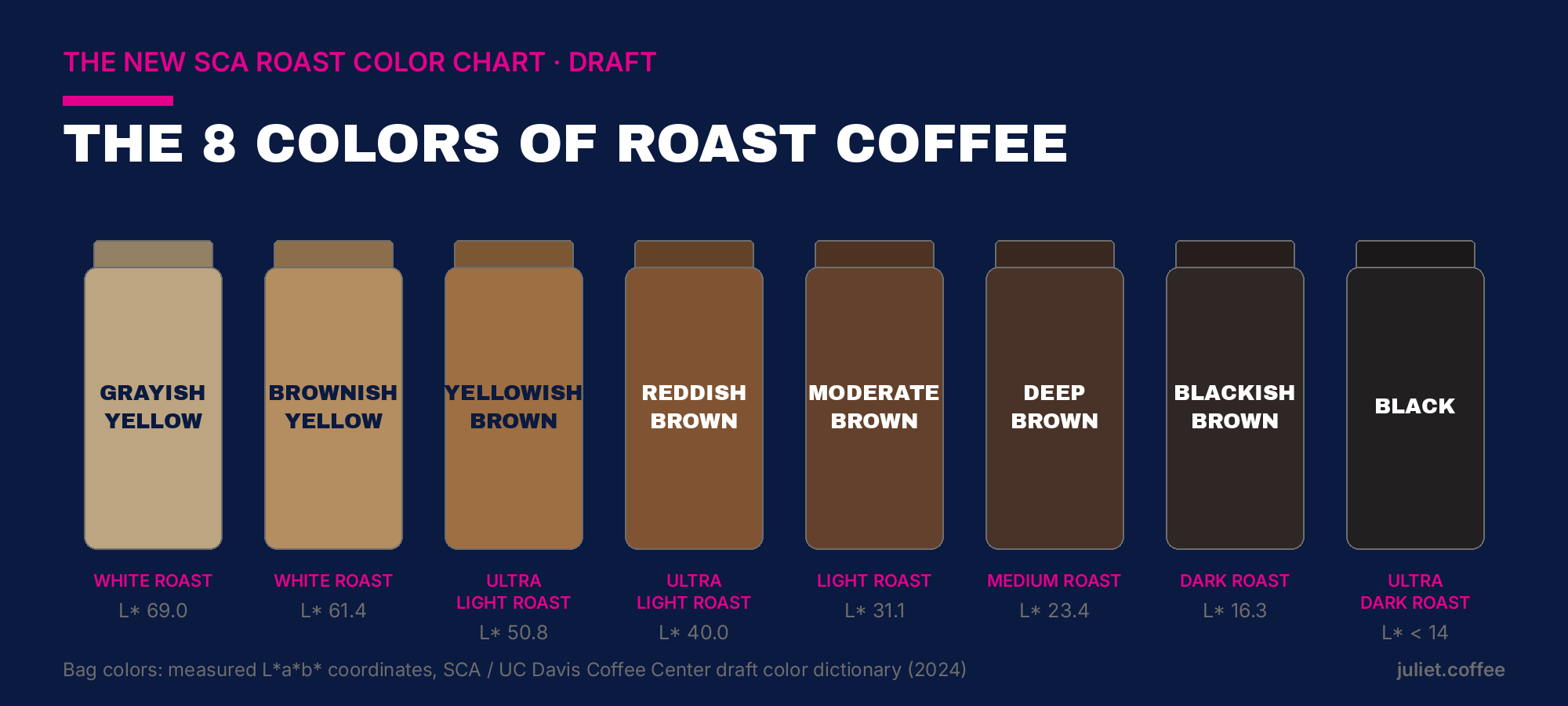
I mean, choosing "Deep Brown" makes more sense to most people than "Full City +", but I'll miss a bit those days of mystery and guessing that were what coffee roasting color was.
How to Measure Your Own Roast Color
One more wrinkle: the old SCA standard, the Agtron scale, wasn't actually measuring color at all. Agtron machines read near-infrared reflectance, which is light your eye can't see, then report a number from about 100 (very light) down to 20 (very dark).
It correlates with roast level, but it's proprietary, the machines cost more than your first car, and infrared isn't color you can see. That's a big part of why the SCA is moving to a visible-light CIELAB standard: it measures what you actually see, and the sensor in your phone camera can play along.
So, if you wanted to know what color your coffee is, whether it's a bag of Starbucks or the lightest ghost-roast from GHipster Centrál (the G is silent, of course), now you know what to call it.
If you wanted to go batshit crazy and buy your own lab-grade device like the X-Rite Color i5 spectrophotometer I resurrected from eBay purgatory, you could...but that's another story.
For now, you know enough about coffee color, how it's measured, and how it's supposed to be labeled to make better choices for you when it comes to the coffee you like.
Enjoy your cup!
The Original Papers
If you want to go deeper on any of the research cited, here's where to find them:
- Laudia Anokye-Bempah, Timothy Styczynski, William D. Ristenpart, and Irwin R. Donis-González, "A Universal Color Curve for Roasted Arabica Coffee," Scientific Reports 15 (2025): 24192. The peer-reviewed research behind the universal coffee color curve — open access, free to read.
- Laudia Anokye-Bempah, Irwin R. Donis-González, and William D. Ristenpart, "What Color Is Your Coffee?" 25, Issue 21, Specialty Coffee Association (2024). The plain-language summary of the research, including the draft 22-shade color dictionary the table above is drawn from.
- Specialty Coffee Association, "Developing Roast Color Standards for the Specialty Coffee Industry: A New Roast Color Measurement Approach" (white paper, October 2025). The SCA's case for moving from Agtron near-infrared readings to a visible-light CIELAB standard; newer SCA publications are collected on their research page.
- Natalina C. Bicho, António E. Leitão, José C. Ramalho, and Fernando C. Lidon, "Application of Colour Parameters for Assessing the Quality of Arabica and Robusta Green Coffee," Emirates Journal of Food and Agriculture 26, no. 1 (2014): 9–17. Green-bean CIELAB for Arabica and Robusta, showing how processing and origin shift green coffee along the green-to-yellow/red axis — one of the sources behind the scatter cloud's spread.
- Yusianto, Retno Hulupi, Sulistyowati, and Cahya Ismayadi, "Physical, Chemicals and Flavors of Some Varieties of Arabica Coffee," Pelita Perkebunan (Coffee and Cocoa Research Journal) 21, no. 3 (2005): 200–222. Green-bean CIELAB across nine Arabica varieties; the between-variety color spread that, with Bicho et al., sizes the scatter cloud around UC Davis's measured green mean.